

Tuesday morning, 8:07, coffee in one hand and your laptop bag in the other, is not the time to discover that your outfit needs a rescue mission. Capsule wardrobe women for work is my answer to that kind of morning. It is not about owning almost nothing, and it is not about dressing like everybody else in the office. It is about building a small set of clothes that work together, sit well in a client chair, and make getting dressed feel like a quick decision instead of a fresh problem.
How to start a capsule wardrobe women for work without buying everything at once
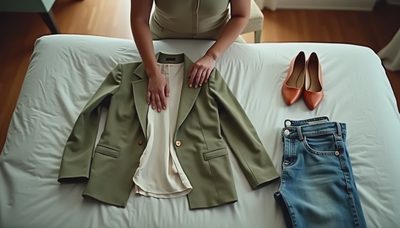
Start with the pieces that have the hardest job. I like two blazers, two pairs of trousers, one skirt or simple dress if you wear those, four to six tops, one sweater or cardigan, and two pairs of shoes you can walk in. That is enough to create real combinations without turning your closet into a storage unit. If you shop smart, places like J.Crew, Ann Taylor, Banana Republic, Talbots, and Quince can all be useful hunting grounds. In real money, think roughly $60 to $120 for a blouse, $90 to $180 for trousers, $120 to $250 for a blazer, plus $20 to $40 for a hem or sleeve tweak.
Fit is where this either starts working or gets expensive fast. A blazer should close without pulling across the back, and it should still look neat when you sit down. Pants should skim, not grab, at the hip and thigh. If a sleeve is too long or a hem puddles on the floor, that is a tailoring bill, not a disaster. I have seen more women waste money on almost-right clothes than on obviously bad ones. The almost-right ones stay in the closet because they never feel easy.

Choose a color story that survives client meetings and laundry day
Pick a palette that does not fight itself. Navy, charcoal, black, ivory, camel, and one softer accent color can carry most offices without looking stiff. If your workplace leans formal, keep the base darker and cleaner. If it is more office-adjacent, a warmer mix with cream, olive, or soft blue feels current without chasing trends. The point is repeatability. If your blazer works with three tops and both pairs of pants, it is earning its space.
Fabric matters just as much as color. Ponte knits hold up better than flimsy jersey, wool blends drape better than scratchy synthetics, and cotton poplin gives a shirt some structure so it does not collapse by lunch. I also like one top that feels a little more polished than the rest, like a silk blend or a fine-gauge knit, because it saves you on days when the calendar gets crowded. When the base colors and fabrics are calm, your shoes and bag do not have to do the heavy lifting.
Build outfit formulas, not random outfits
A capsule wardrobe women for work should make Monday through Friday boring in the best way. That sounds unexciting until you realize boring outfits are the ones you can repeat without thinking. My favorite formulas are blazer plus shell plus trouser, cardigan plus blouse plus skirt, sweater plus trouser plus loafer, and dress plus blazer plus flat. Those combinations work because each piece has a job and nothing is trying too hard. You do not need a different style identity every day; you need a few reliable equations.
Once you have the formulas, mornings get easy. If the meeting is internal and relaxed, swap the blazer for a cardigan. If you have a presentation, add the jacket and choose the shoe that looks sharpest. If you know you will be sitting through a long day, choose fabrics that do not wrinkle at the first wrinkle of life. That is where the whole system starts paying for itself. You stop dressing by mood and start dressing by function.

What to buy first when your closet is already crowded
If your closet is full but nothing works together, do not start with more tops. Start by identifying the item that creates the most outfits. For some women, that is a navy blazer. For others, it is a straight-leg trouser in a neutral color or a shoe that can handle eight hours without making you count the minutes. I would rather see one pair of loafers that can do real work than three pairs that only look cute standing still. Naturalizer, Vionic, Clarks, and Cole Haan are all common places to look when comfort matters as much as polish.
Then clear out the duplicates that only survive because they are familiar. If you have four nearly identical black tops and only one actually holds its shape, the other three are just taking up space. A good test is to lay out five outfits you actually wore in the last month and note what keeps repeating. That tells you what the wardrobe is already asking for. You are not shopping for fantasy outfits; you are filling the gaps in the life you actually have.
Keep the system working after the first month
The best closets are maintained, not reinvented. Hang blazers so they keep their shape, steam trousers before the week starts, and replace anything that has turned thin at the elbows, shiny at the seat, or stubbornly wrinkled in a way the iron cannot fix. I also keep a quick cost-per-wear note on my phone for anything over $50. That sounds fussy until you realize a $180 blazer worn twice a week beats a $40 top that never leaves the hanger. The math is the truth-teller.
If you want this to stay easy, do one small reset every Sunday night. Put the work shoes back where you can reach them, pair the bottoms with the tops that already worked, and make sure there is one clean layer ready for colder mornings. Capsule wardrobe women for work is not supposed to become a second job. When it is doing its job, getting dressed takes five minutes and the outfit stops being the story. Start with one blazer, one good pant, and two tops that all play nice together, then build from there.