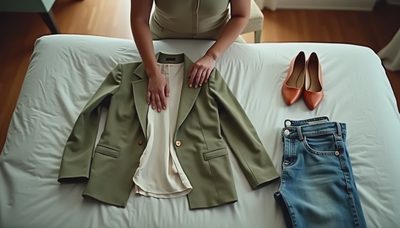


Tuesday morning, 8:10 a.m., and I’m standing in my closet with three blouses I don’t love and one blazer that does not want to button. That is where a capsule wardrobe for work earns its keep. It is not about dressing like a minimalist poster. It is about having a small group of clothes that work together, look polished in a conference room, and keep you from buying another “maybe” shirt you never reach for. If your week includes client meetings, school drop-off, and a late lunch across town, this approach saves time and money without making you look plain.
Start with the meeting calendar, not the hanger
The first step in a capsule wardrobe for work is to look at your actual week. If you sit in a corporate office, you need different clothes than someone who works from home and heads out for two appointments a week. If you are on camera half the day, you need smoother fabrics and fewer fussy details. Start by choosing a base of about 12 to 15 pieces you can mix without thinking: two jackets, three tops, two bottoms, one dress, and two pairs of shoes will cover more ground than a crowded closet full of single-use items.
I like to think in terms of the most common work moment: sitting down, standing up, walking into the lobby, then heading to lunch without changing. That means sleeves that do not fight with your tote, hems that do not ride up in a chair, and shoes you can walk in for more than twenty minutes. This is where brands like Ann Taylor, Talbots, J.Crew, Banana Republic, Quince, and Everlane often make sense because they carry the kinds of basics that can be repeated. You do not need a giant wardrobe. You need a reliable one.
The five workhorses I would buy first
If you are building from scratch, begin with pieces that do the heaviest lifting. A structured blazer in navy, black, or camel gives you instant polish and can pull jeans or trousers into work mode when the day runs long. A straight-leg or slim ankle pant in a neutral color gives you a clean line under longer tops. A knit shell or fine-gauge sweater sits under jackets better than a stiff blouse and usually travels well. A dress that works on its own and under a blazer adds range. Finish with one low-heeled shoe, either a loafer or a block heel, plus one flat that can handle a full day.
Price matters here. A good ponte pant might run $60 to $120. A blazer can land anywhere from $120 to $250, with better tailoring usually showing up in the higher range. Shoes from Cole Haan or Naturalizer often sit around $80 to $160, and a quick hem from a local tailor may cost $20 to $35. None of that is cheap, but when you repeat the pieces all month, the cost per wear gets honest fast. That is the part I always tracked on my phone when I was working in banking.

Color and fabric do most of the heavy lifting
The capsule wardrobe for work works best when the palette stays small. Navy, black, charcoal, camel, ivory, and one accent color you actually like will get you farther than six bright shades that refuse to match. If you love color, keep it controlled. A deep green shell under a navy blazer is easier to repeat than a pile of statement prints that only work on one Tuesday in May.
Fabric matters just as much. Look for wool blends, ponte, stretch cotton, and smooth knits that do not wrinkle at the first car ride. A blazer that still looks neat after an hour in the passenger seat is worth more than a prettier one that needs constant fixing. The same goes for tops. If a blouse gaps, clings, or needs dry cleaning after every wear, it will not survive a real work week. Good clothes, no drama means the fabric should help you, not ask for a full-time assistant.
Build outfits from formulas, not inspiration
One reason the capsule wardrobe for work feels easier after a few weeks is that you stop trying to invent outfits and start using formulas. A blazer plus straight-leg pant plus knit top is one formula. A dress plus cardigan plus low heel is another. A blouse tucked into an ankle pant with a loafer gives you a third. Once you have three formulas, you can make ten outfits without adding a single new piece.
This is also where repetition starts to feel smart instead of boring. If your navy pant works with three tops and two shoes, that is six combinations already. If your camel blazer works over a dress and with trousers, it earns its place fast. I would rather see a woman wear the same great blazer ten times than own ten blazers that are all slightly wrong. In a real office, people remember whether you looked put together, not whether you wore the same jacket last Thursday.

Shop like you are solving a problem, not hosting a haul
The capsule wardrobe for work is a lot cheaper when you buy in layers. Start with the biggest gap in your closet, not the prettiest item online. If your shoes are the weak spot, fix shoes first. If every pant you own needs a tug every time you stand up, replace the pant before buying another blouse. A smart starter budget is often $600 to $1,200 if you need several core pieces at once, but it can be much lower if you already own a solid blazer or good shoes.
Before you buy, try the chair test, the tote test, and the wrinkle test. Sit down in the dressing room. Put your bag over your shoulder. Bend to pick something up. If the piece fails any of those, it is not going to make your Monday easier. Tailoring can save a near-miss, too. A $25 hem or a $30 waist adjustment is usually money well spent if the garment becomes one of your best pieces.
The clutter that makes a closet feel full but useless
The fastest way to waste money is to buy items that cannot play well with others. Too many prints, too many trend details, and too many “special occasion” tops make a closet feel busy while still leaving you stuck. The same goes for shoes that look cute but hurt by 2 p.m. I learned long ago that a shoe you cannot walk in is not a work shoe, no matter how nice it looks on a shelf.
A better test is simple: can this piece work with at least three things I already own? If the answer is no, it needs a very good reason to come home with you. That one question cuts down on closet clutter fast. It also keeps you from building a wardrobe that looks impressive on a hanger but disappoints when you need to get dressed in ten minutes.
When you are ready to make your own capsule wardrobe for work, start with one blazer, one pant, one top, and one shoe you can repeat next week. That is enough to get the whole thing moving, and it is usually where the confidence shows up first.